


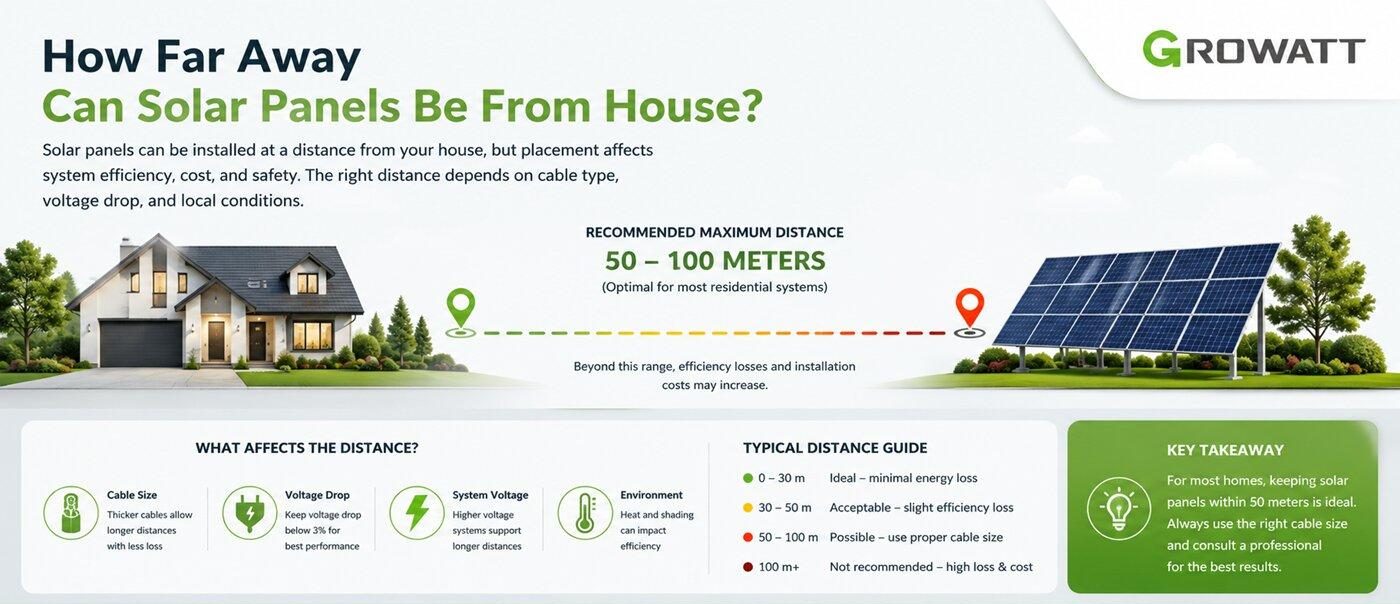
There is no universal maximum distance between solar panels and a house. A solar array can be installed away from the building, but the practical distance depends on cable length, system voltage, current, voltage drop, inverter location, shading, and local electrical requirements.
What Is the Best Distance Between Solar Panels and a House?
When there is enough suitable roof space, installing the panels on the house is often the simplest option. The cable run is usually shorter, the installation requires less additional infrastructure, and maintenance is easier.
But being close to the house is not automatically better.
A roof section that is heavily shaded by another building, chimney, tree, or nearby structure may produce less energy than a ground-mounted array located farther away in an unobstructed area. In that situation, moving the panels away from the house can make more sense.
The goal is to find a location where the array receives good sunlight while keeping the electrical connection practical.
| Factor | Effect on Panel Location |
|---|---|
| Distance from house | Affects cable length and installation cost |
| Shading | May reduce solar energy production |
| Cable size | Larger conductors can reduce resistance and voltage drop |
| System voltage | Higher voltage can reduce current for the same power |
| Inverter location | Changes the length of DC and AC cable runs |
| Roof condition | May limit the available mounting area |
| Ground space | Can make a separate solar array possible |
| Local regulations | May affect mounting and electrical installation |
How Far Can Solar Panels Be From a House?
There is no universal maximum distance between a solar array and a house.
A small residential system might be installed close to the building, while a ground-mounted system could be positioned much farther away. What matters is whether the electrical system has been designed for that distance.
As the distance increases, the cable run becomes longer. Cable resistance then becomes more relevant, particularly when the system carries substantial current. This can result in voltage drop and electrical losses.
For that reason, a designer should not simply choose a location and then connect the panels with whatever cable happens to be available.
The distance, cable size, operating voltage and current should be considered together.
Does Distance Affect Solar Panel Efficiency?
Distance itself does not make a solar panel less efficient.
A panel installed 10 metres from a house does not suddenly become less efficient than the same panel installed 5 metres away. The issue occurs in the electrical connection between the panels, inverter and building.
A longer cable run can introduce additional resistance. That resistance can cause voltage drop and energy losses, especially if the cable is undersized or the current is relatively high.
This is why two systems with identical solar panels can have different electrical losses depending on how they are wired.
The panel is not necessarily the problem. The wiring design is.
How Cable Length Affects Solar Power Loss
Every electrical cable has resistance. When current flows through the conductor, some energy is dissipated as heat.
The basic relationship is commonly expressed as:
Power loss = I² × R
where:
- I is the current
- R is the resistance of the cable
Cable resistance increases as the cable gets longer and decreases as the conductor’s cross-sectional area increases.
That gives us a simple practical rule:
Longer cable + higher current + undersized conductor = greater potential voltage drop and power loss.
This is why cable sizing becomes particularly important when solar panels are installed far from the inverter or house.
Factors that influence voltage drop
| Factor | What Happens |
|---|---|
| Longer cable | Resistance increases |
| Higher current | Voltage drop increases |
| Larger conductor | Resistance decreases |
| Higher system voltage | Current can be lower for the same power |
| Higher temperature | Conductor resistance can increase |
| Poor connections | Can introduce additional resistance and heating |
The actual cable size should be selected using the electrical specifications of the system and the applicable installation requirements rather than by distance alone.
How Far Can Solar Panels Be From an Inverter?
This is a slightly different question from the distance between the panels and the house.
| Layout | DC Cable Run | AC Cable Run | Main consideration |
|---|---|---|---|
| Inverter near house | Longer | Shorter | Higher DC voltage-drop consideration |
| Inverter near panels | Shorter | Longer | AC cable sizing becomes important |
| Midway location | Medium | Medium | May balance both cable runs |
In many solar installations, the inverter is installed relatively close to the PV array to keep the DC cable run manageable. The AC output can then be carried from the inverter toward the building’s electrical system.
For example:
Solar panels → DC cables → inverter → AC cables → electrical panel → house
The inverter does not necessarily need to be inside the house.
Depending on the system design, it may be mounted near the solar array, in a suitable utility area, or in another location that meets the manufacturer’s installation requirements.
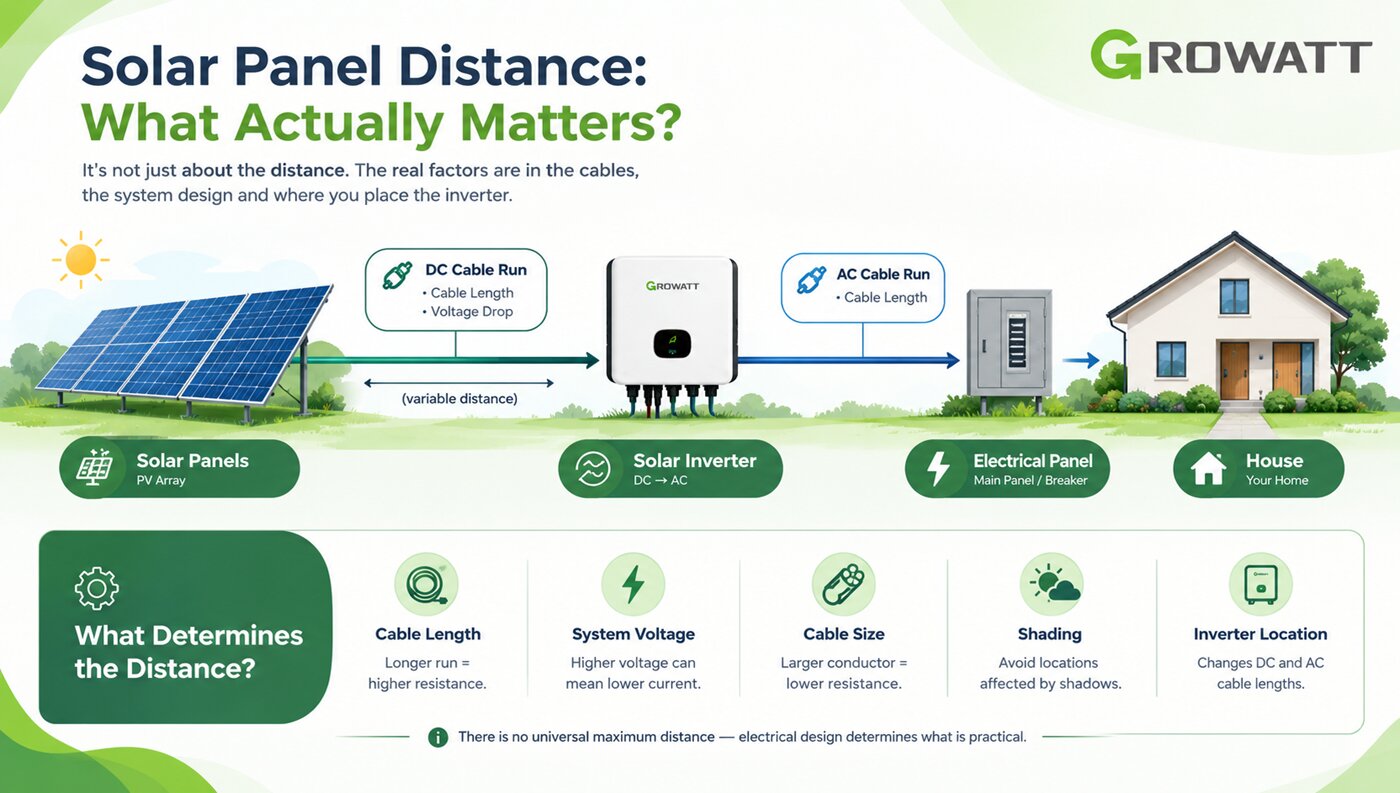
Moving the inverter closer to the panels can shorten the DC cable run. Moving it closer to the electrical panel can shorten the AC run.
There is a trade-off.
The best position depends on the system voltage, current, cable size, inverter specifications, environmental conditions and installation requirements.
DC Cable Distance vs AC Cable Distance
One detail that is often overlooked is that the total physical distance is not the only thing that matters.
Consider a ground-mounted array located 40 metres from a house.
There are several possible layouts:
Option 1
Panels → 40 m DC cable → inverter → short AC connection → house
Option 2
Panels → short DC cable → inverter near array → 40 m AC cable → house
These two arrangements do not have identical electrical characteristics.
The current, voltage and cable requirements on the DC and AC sides can be different, so simply saying that the panels are “40 metres away” does not tell us whether the installation is suitable.
This is also why the inverter should be included in any discussion about solar panel distance.
What Factors Determine the Distance From Solar Panels to a House?
Several practical factors should be checked before choosing the installation location.
1. Cable Length and Voltage Drop
This is one of the main electrical considerations.
If the array is far from the inverter or electrical connection point, the cable may need to be larger to keep voltage drop within an acceptable range.
Increasing conductor size can, however, increase material and installation costs. The point is not to use the biggest possible cable, but to select an appropriate size for the actual system.
2. Solar System Voltage
System voltage has a direct relationship with current.
For the same power:
Higher voltage → lower current
Lower current can reduce resistive losses for a given cable.
This is one reason why system voltage should be considered when evaluating a long-distance PV installation. A 48 V battery-based system, for example, has very different cable requirements from a high-voltage PV string.
3. Cable Size
Cable length should never be considered on its own.
A longer run using an appropriately sized conductor may be perfectly practical, while a shorter run using an undersized cable can create unnecessary losses or heating.
Cable selection should account for:
- maximum current
- operating voltage
- cable length
- conductor material
- ambient temperature
- installation method
- applicable electrical standards
4. Shading From the House
The house itself can become a source of shade.
The effect changes throughout the day and across the year, so checking the site only at one particular time is not enough.
Trees, walls, chimneys, neighbouring buildings and other structures should also be considered.
Sometimes moving a ground-mounted array farther away from the house gives the panels substantially better solar exposure.
5. Available Roof Space
A roof may look large from the ground but offer less usable area once skylights, vents, chimneys, roof edges and shaded sections are excluded.
If the usable roof area is limited, a ground-mounted system can provide another option.
6. Inverter Location
The inverter is effectively the link between the PV array and the property’s electrical system.
Its location affects cable routing, maintenance access and environmental conditions. It also determines how much of the connection uses DC cabling and how much uses AC cabling.
7. Ground-Mounted System Layout
Ground-mounted panels naturally provide more flexibility in choosing the array’s position.
However, additional distance can mean:
- more cable
- more trenching or conduit
- additional installation work
- greater voltage-drop considerations
- more complex cable protection
So the cheapest mounting location is not necessarily the one with the shortest distance, and the shortest distance is not necessarily the best solar location.
Can Solar Panels Be Installed Far Away From the House?
Yes.
A ground-mounted solar array can be installed away from the house when the property allows it and the electrical system is designed accordingly.
This arrangement is common when the roof is unsuitable, shaded, too small, or difficult to access.
The main question is not simply whether the panels are far away. It is whether the complete system can safely and efficiently transfer the generated electricity to the inverter and electrical connection point.
For a remote array, the installation plan should account for cable routing, protection, conduit or trenching, voltage drop, environmental exposure and access for future maintenance.
What Happens If Solar Panels Are Too Far From the House?
There is no particular distance at which a solar system suddenly stops working.
Instead, problems tend to appear gradually as the electrical design becomes less suitable for the cable run.
Potential issues include:
- increased voltage drop
- higher cable losses
- larger cable requirements
- increased material cost
- more complicated installation
- longer cable routes
- additional maintenance considerations
In extreme cases, an incorrectly designed long cable run can affect the voltage seen by the inverter and the overall operation of the system.
That is why “How far can I place the panels?” is not really a distance-only question.
It is an electrical design question.
How to Calculate Solar Panel Cable Distance and Voltage Drop
A basic voltage-drop calculation starts with the resistance of the conductor and the current flowing through it.
For a DC circuit, the cable length normally needs to account for both the outgoing and returning conductors.
A simplified relationship is:
Voltage drop = Current × Resistance
And because cable resistance depends on conductor length and cross-sectional area, increasing the distance generally increases the resistance of the circuit.
For a real installation, the calculation should use the actual:
- PV operating voltage
- maximum current
- one-way cable distance
- conductor size
- conductor material
- operating temperature
- cable type
Simple design example
Suppose a ground-mounted solar array is installed some distance from the inverter.
Instead of asking only:
“Is 30 metres too far?”
the better questions are:
- What is the PV voltage?
- What current will flow through the cable?
- What cable size is being used?
- What is the total circuit length?
- What percentage of voltage drop is acceptable for the design?
- Where will the inverter be installed?
Without those details, a distance in metres or feet does not tell us whether the system is properly designed.
Roof-Mounted vs Ground-Mounted Solar Panels
Both installation methods can work well. The practical differences are mostly related to space, shading, access and cable routing.
| Feature | Roof-Mounted | Ground-Mounted |
|---|---|---|
| Distance from house | Usually short | Can be much longer |
| Roof condition | Must be suitable | Not relevant |
| Shading flexibility | Limited by roof location | More freedom to choose location |
| Cable routing | Often simpler | May require longer runs |
| Maintenance access | Depends on roof access | Usually easier to reach |
| Available area | Limited by roof | Depends on property |
| Installation structure | Roof mounting system | Ground mounting structure |
A ground-mounted system makes sense when the available ground space gives the array better solar exposure or provides more usable installation area.
Choosing the Right Location for Solar Panels
Before deciding where the panels should go, look at the entire system rather than just the array.
A practical site check should include:
- Sun exposure: Is the array free from significant shading?
- Distance: How far is it from the inverter and electrical connection?
- Cable route: Can cables be installed and protected properly?
- Voltage drop: Is the cable size suitable for the distance and current?
- Inverter location: Is there a suitable place for the inverter?
- Maintenance: Can the panels and equipment be accessed safely?
- Environment: Are the inverter and cables protected according to their specifications?
- Local requirements: Are there building or electrical rules affecting the installation?
If you are comparing equipment for a residential system, the inverter’s specifications also matter. For example, an On grid 5 kw inverter will have different electrical characteristics and design considerations from a larger commercial inverter.
For projects involving local equipment selection or installation requirements, information about a solar inverter uae market can also be useful when the system is being designed for the UAE.
For systems that operate independently of the utility grid, the calculation can be different again. An Off grid inverter may be connected to batteries and loads, so the cable distances between the PV array, inverter, battery bank and loads all need to be considered.
Frequently Asked Questions
How far can solar panels be from a house?
Solar panels can be installed a considerable distance from a house if the system is properly designed. There is no universal maximum distance. Cable length, voltage drop, conductor size, system voltage, inverter location, shading, and local electrical requirements all influence the practical distance.
Does distance from the house reduce solar panel efficiency?
Distance from the house does not directly reduce the efficiency of solar panels. However, longer cable runs can introduce resistance, voltage drop, and electrical losses. Proper cable sizing and system design can help keep these losses under control.
How far can solar panels be from an inverter?
There is no single distance that applies to every solar installation. The practical distance depends on PV voltage, current, cable size, cable type, temperature, installation method, and allowable voltage drop. The inverter location should be selected as part of the overall electrical design.
Can solar panels be installed 100 feet from a house?
A 100-foot distance can be practical for some solar installations, but the distance alone does not determine whether the system will work properly. Cable size, system voltage, current, inverter location, and voltage drop should be evaluated before installation.
Is it better to install the inverter close to the solar panels?
Installing the inverter relatively close to the PV array can reduce the length of the DC cable run. However, the best inverter location also depends on the AC connection, environmental conditions, maintenance access, and the manufacturer's installation requirements.
What causes voltage drop in solar panel cables?
Voltage drop is mainly affected by cable resistance and current. Longer cables and higher current increase voltage drop, while larger conductors generally reduce resistance. System voltage, conductor material, temperature, and installation conditions should also be considered when sizing solar wiring.
Can ground-mounted solar panels be installed away from the house?
Yes. Ground-mounted solar panels can be installed away from the house when sufficient space and suitable sunlight are available. The electrical design should account for the longer cable route, voltage drop, cable protection, inverter location, and maintenance requirements.
Does a longer solar cable waste more electricity?
A longer solar cable can result in greater electrical losses because cable resistance increases with length. The amount of loss depends on factors such as current, conductor size, conductor material, temperature, and total circuit length.
How do I calculate the right cable size for a long solar cable run?
Cable sizing should take into account the maximum current, system voltage, total cable length, conductor material, temperature, installation conditions, and permitted voltage drop. For a real installation, the calculation should follow applicable electrical requirements and the specifications of the solar equipment being used.
Should solar panels be closer to the house or the inverter?
The answer depends on the system layout. Comparing the DC and AC cable runs, voltage drop, equipment location, environmental conditions, and installation requirements gives a more useful answer than choosing a fixed distance between the panels and the house or inverter.
Can solar panels be installed on a separate building?
Yes. Solar panels can be installed on a garage, workshop, carport, outbuilding, or separate ground-mounted structure. When the array is separated from the main house, the cable route and electrical connection should be included in the system design from the beginning.
What should I consider before installing solar panels far from my house?
Before installing solar panels far from a house, consider sunlight exposure, shading, cable distance, voltage drop, cable size, inverter location, cable protection, maintenance access, and local installation requirements. A qualified solar installer can evaluate these factors and determine whether the proposed location is practical.


One thought on “How Far Can Solar Panels Be From a House?”
Bonjour,
Nous avons 12 panneaux sur le toit, panneaux américains sun power de memoire.
La gestion se fait avec des modules enphase et une passerelle Comwatt.
A 35 mètres environ, nous avons un espace totalement ensoleillé et j aimerais ajouter des panneaux au sol plein sud.
Avez vous du matériel compatible avec notre installation pour éviter deux applications ?
Merci