If you want to choose the right solar inverter based on load power and peak demand, you simply need to add up the running watts of everything that will be on at the same time, and then add the starting surge of your largest appliance to that total. That final number is your absolute minimum requirement.
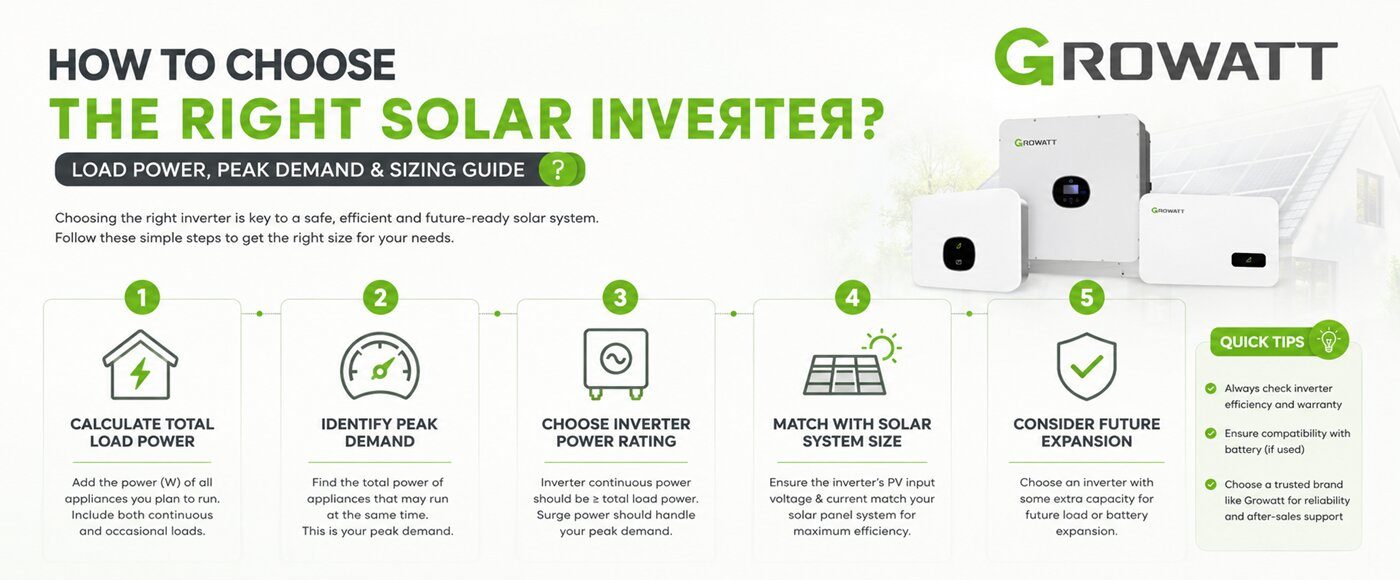
In simple terms, your inverter has to be strong enough to support the constant load of your daily usage, but robust enough to support the sudden “kick” of your air conditioner or water pump starting up. Get those two numbers right, and you are already 90% of the way to making a perfect choice.
The solar inverter you choose has to be able to handle that total running number comfortably all the time and able to support that peak surge for a few seconds without shutting down . For a factory owner, not considering the peak demand is the shortest path to unexpected downtime and costly interruptions.
First, Let’s Talk About Your “Everyday” Load and “Peak Demand”
Before you even look at specs sheets, you need to walk your facility or review your client’s equipment list. Don’t rely on guesses. List every device from the massive HVAC units and conveyor belts down to the office lighting and computers. You need two numbers for each:
– Continuous Power (Rated Watts): What does it draw to stay on?
– Surge Power (Peak Watts): What does it draw for the first 2-3 seconds to start up?
For example, a refrigeration compressor might run at 1,500W but require 4,500W to start. If you add up the running watts of all equipment (say 15kW) but fail to account for that startup spike, a 15kW inverter will trip the moment the compressor kicks in. To choose the right solar inverter, you must add the largest single surge to the total running watts of everything else. This total surge number is your non-negotiable baseline.
So, when you choose the right solar inverter, you have to look at your list and find the appliance with the highest starting surge. Take that number, and add it to the running watts of everything else that might be on at the same time. That big number is your target.
Note to always leave room to grow. Maybe next summer you’ll buy a new air conditioner. Maybe you’ll turn that spare room into a small home office with extra electronics. Life changes. Once you have done your math, add about 20-30% on top of that final number. It gives your system room to breathe, and it means you won’t have to start from scratch if your needs change down the road. It’s just a nice way to protect your peace of mind.
Efficiency and Quality Matter
Size is a factor, but quality and efficiency should not be overlooked. Quality solar inverters, such as Growatt inverters, are built to be efficient regardless of the load and come equipped with features such as advanced MPPT technology, strong protection functions, and the ability to perform well in difficult conditions such as those found in an industrial setting.
When selecting a solar inverter, it is also necessary to consider the efficiency level of the inverter. Look for an inverter with an efficiency level of 98% or higher to get the most out of your energy conversion. Efficient inverters pay for themselves over time through better energy yield and reduced operational costs.
Match Inverter Type to Your System
There are several types of solar inverters, including string inverters, central inverters, microinverters, and hybrid inverters. For instance, in most industrial settings, string inverters or central inverters are generally preferred for their ability to support large loads. For systems with higher and more variable power demands, a growatt 15kw hybrid inverter can be considered when both load requirements and future energy storage needs are taken into account. Microinverters, on the other hand, are not ideal for use in large factories but work well in residential or commercial settings.
When choosing the right solar inverter, also consider the system configuration. For example, if you plan to add energy storage or integrate with a grid-tied system, a hybrid inverter might be the best choice. Growatt offers a range of hybrid inverters that provide flexibility and future-proofing for your solar investment.
Evaluate the Environmental and Technical Conditions
Your inverter must withstand the environmental conditions of your location:
Temperature Tolerance:
Ensure the inverter can operate efficiently within local temperature ranges.
Ingress Protection (IP) Rating:
For outdoor installations in harsh climates, select inverters with high IP ratings to prevent dust and water ingress.
Grid Compatibility:
Confirm the inverter supports local grid standards and regulations.
Reliability and After-Sales Service
You should also focus is on smooth operations. That’s why choosing a reputable brand like Growatt is crucial. Growatt inverters are known for their durability, advanced features, and excellent after-sales support. Make sure the inverter you choose comes with a valid warranty and access to reliable technical support—especially important if you’re operating in countries where after-sales service might be less accessible.
Need help choosing the right inverter for your project? Contact our team for a professional system recommendation.
Conclusion
At the end of the day, choosing an inverter is really about choosing reliability. Do the simple math: calculate your running load, find your biggest surge, and add a buffer. Then, wrap that technical choice in the warmth of a trusted brand.
When you choose the right solar inverter—one like Growatt that respects your investment and stands by its word—you aren’t just buying equipment. You are buying years of quiet evenings with the lights on, cool afternoons in the middle of summer, and the simple joy of a home that takes care of itself.
Your success in solar energy begins with choosing the right components. Make the smart choice — choose Growatt.
How do I calculate the right solar inverter size for my system?
To choose the right solar inverter, add the total running watts of all devices operating at the same time, then add the highest startup surge from your largest appliance. Finally, include a 20–30% safety margin.
Why is peak demand important when selecting a solar inverter?
Peak demand represents the short startup surge required by appliances such as air conditioners or compressors. If the inverter cannot handle this surge, it may shut down or trip during operation.
Should I oversize my solar inverter?
Yes, adding a 20–30% buffer above your calculated load helps accommodate future expansion and prevents overload during unexpected peak usage.
What efficiency rating should I look for in a solar inverter?
Look for a solar inverter with at least 98% efficiency. Higher efficiency improves energy conversion, increases yield, and reduces long-term operational costs.
Does inverter type affect performance in industrial settings?
Yes. String or central inverters are typically better suited for industrial applications with large loads, while microinverters are more common in residential systems.