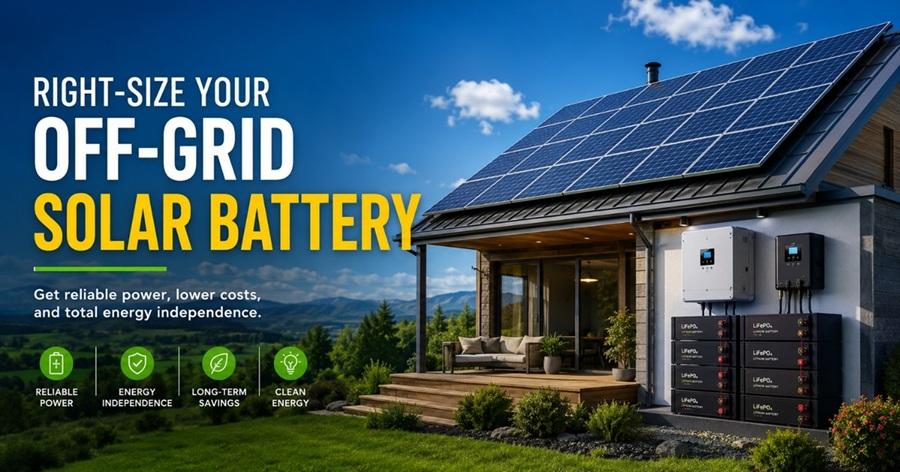
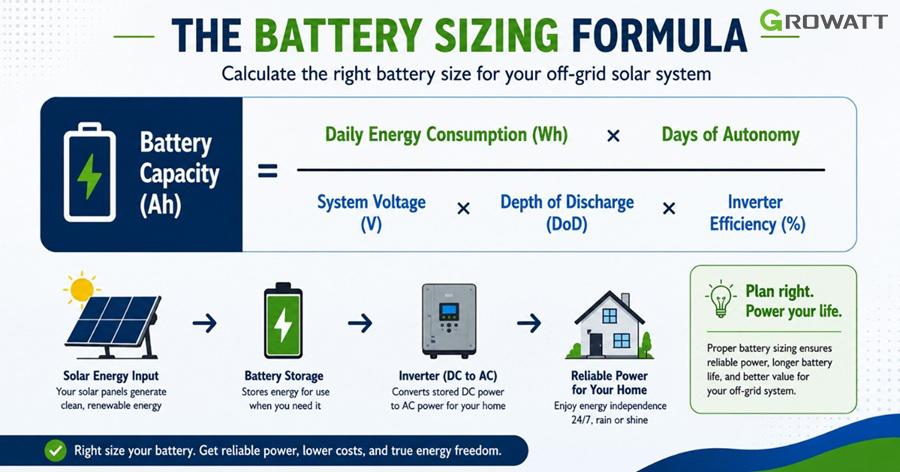
Before attempting to calculate solar battery capacity, you should gather accurate information about your daily loads and desired backup time. You can use this formula to work out the process of calculating battery capacity for off-Grid Solar inverter:
Battery Capacity (Ah) = (Daily Energy Consumption in Wh * Days of Autonomy) / (System Voltage * Depth of Discharge * Inverter Efficiency).
To calculate battery capacity for solar inverter installations correctly, it is important to account for both inverter efficiency and battery depth of discharge.
A typical home that consumes 5,000Wh per day with two days of autonomy usually requires a 48V lithium battery bank of around 300Ah. This calculation will help you avoid the common pitfalls of undersizing (leaving you without power), or oversizing (wasting money).
| Battery Sizing Factor | Why It Matters | Potential Problem if Ignored |
|---|---|---|
| Daily Energy Consumption | Determines the amount of energy that must be stored each day | Battery may run out before the end of the day |
| Days of Autonomy | Provides backup during cloudy periods and at night | Insufficient power during extended low-sun conditions |
| Depth of Discharge (DoD) | Determines the usable portion of battery capacity | Reduced battery lifespan due to excessive discharge |
| System Voltage | Influences current flow and overall system efficiency | Higher wiring losses and inefficient operation |
| Inverter Efficiency | Accounts for energy lost during DC-to-AC conversion | Battery bank may be undersized by 5–10% |
When designing an off-grid solar system, you need to pay close attention to several important components. One of the most important, and often misunderstood, is the sizing of the battery capacity. In this guide we will discuss the formula you need, the practical real-world factors that influence the sizing of your battery and some practical examples to help you decide.
The Importance of Proper Battery Capacity
Selecting the correct solar inverter battery capacity helps ensure that enough energy is available during periods of low solar generation. Unlike a grid-tied system, an off-grid solar system has no utility backup. When the sun is not shining (at night or when it’s cloudy for long periods), your battery bank is your only source of power.
There are several important advantages to correctly sizing your batteries:
– Dependable power delivery, day in and day out
– Prevented over discharge, increased battery life
– Greater system efficiency overall
– Avoidance of unnecessary capital outlays
In short, get the battery size right and you will save yourself money and frustration down the road.
How to Understand Battery Capacity
The required solar battery capacity should always be based on actual energy consumption rather than estimated or occasional usage patterns. Battery capacity is typically expressed in ampere-hours (Ah) or kilowatt-hours (kWh). The basic relationship is straightforward:
Battery energy (Wh) = Voltage (V) × Capacity (Ah)
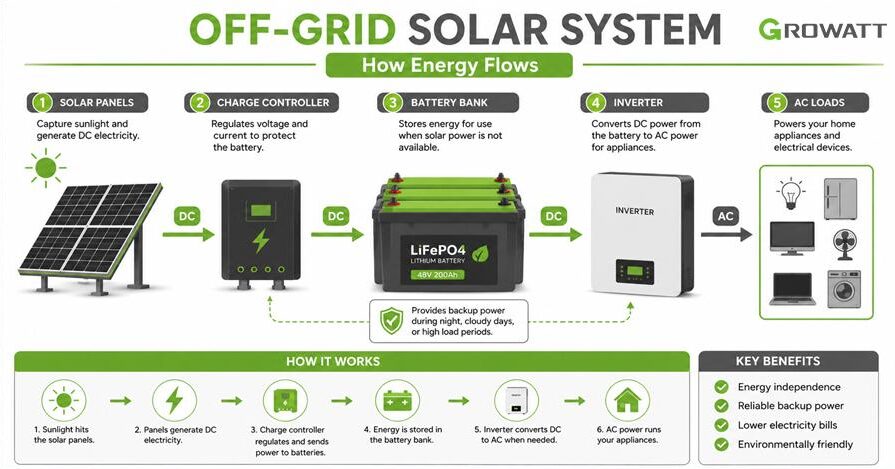
For example, a 48V battery rated at 200Ah stores:
48V × 200Ah = 9,600 watt‑hours, or 9.6kWh
This means that, under ideal conditions, the battery can deliver 9.6kWh of energy when fully charged. However, real-world performance depends on several additional factors, which we will discuss next. Accurate solar inverter battery sizing improves system performance and reduces the risk of frequent battery cycling.
Things to Know Before Determining Your Battery Bank Size
Proper solar battery sizing is one of the most important steps in designing an efficient and reliable off-grid power system.
1. Daily Energy Use
First, find out how much electricity your appliances use on an average day. We can put this information in a simple table:
|
Appliance |
Power (W) | Daily Usage (hours) | Daily Energy (Wh) |
| LED lights | 100 | 5 |
500 |
|
Refrigerator |
150 | 10 | 1500 |
| Television | 100 | 4 |
400 |
|
Laptop |
60 | 6 | 360 |
| Fan | 80 | 8 |
640 |
|
Total |
3,400Wh (3.4kWh) |
||
This is the total daily consumption and it is the basis of your battery capacity calculation.
Actual household consumption varies significantly depending on appliance types and daily usage patterns. The examples below illustrate how a few additional loads can substantially increase battery storage requirements.
| Appliance | Typical Power Consumption | Estimated Daily Usage | Approximate Daily Energy |
|---|---|---|---|
| Wi-Fi Router | 10W | 24 hours | 240Wh |
| Microwave Oven | 1200W | 0.3 hours | 360Wh |
| Washing Machine | 500W | 1 hour | 500Wh |
| Air Conditioner (Small) | 1000W | 4 hours | 4,000Wh |
| Water Pump | 750W | 1 hour | 750Wh |
2. Autonomy Days Conference
Days of autonomy is the number of consecutive days your battery bank can power your loads without any solar charging. Typical suggestions are:
– 1 day – Areas with persistent intense sunshine
– 2-3 days – Areas with moderate weather and occasional cloud cover
– 3-5 days – Locations with frequent overcast conditions or extended rainy periods
Remember, the more autonomy, the more batteries you need, and the more expensive the system.
3. Depth of Discharge (DoD)
Depth of discharge (DOD) is the amount of the battery’s total capacity that can be safely used without damaging the battery or significantly shortening its life.
– Lithium batteries (LiFePO4) – 80% to 95% usable
– Lead acid batteries – Approximately 50% usable
Lithium batteries are more expensive to purchase but have a higher usable capacity and longer cycle life which makes them more economical in the long run. The same battery capacity can provide very different amounts of usable energy depending on its recommended depth of discharge.
| Battery Type | Typical DoD | Usable Capacity from a 10kWh Battery |
|---|---|---|
| Lead-Acid | 50% | 5kWh |
| AGM | 60% | 6kWh |
| LiFePO4 | 80% | 8kWh |
| Premium LiFePO4 | 90% | 9kWh |
4. Voltage of system
Off-grid solar inverters are usually available in three voltage configurations:
– 12V – For small systems like RVs or tiny cabins
– 24V – Good for medium size installations
– 48V – Recommended for off-grid whole home systems
Systems that operate at higher voltages reduce current, and therefore reduce energy losses due to resistance in wiring and components.
5. Efficiency of Inverter:
Efficiency of inverter is less than 100 %. Most modern off-grid inverters have efficiencies of 90 to 98%. So some percentage of energy is lost in the conversion from DC (battery) to AC (appliances). These types of losses should be accounted for in the battery sizing calculations.
The Battery Capacity Standard Formula
The formula is:
Battery Capacity (Ah) = (Daily Wh x Days of autonomy) / (Voltage x DoD x Inverter efficiency)
Example Work: How to Calculate Battery Capacity
| Ambient Temperature | Approximate Available Battery Capacity |
|---|---|
| 25°C (77°F) | 100% |
| 10°C (50°F) | 90% |
| 0°C (32°F) | 80% |
| -10°C (14°F) | 65% |
Let’s apply the formula to a normal case in a house.
System parameters:- Daily energy usage: 5,000Wh (5kWh)
– autonomy days: 2
– System voltage: 48 V – Battery type: Lithium (DoD = 80% or 0.8)
– Inverter efficiency: 95% (0.95)
Step 1 – Determine total needed storage
5000Wh * 2 days = 10000Wh
Step 2 – Apply the formula
Battery Capacity (Ah) = 10,000 / (48 x 0.8 x 0.95) = 10,000 / 36.48 ≈ 274Ah
Recommendation: A good choice would be a 48V, 300Ah lithium battery bank, giving a good safety margin above the calculated minimum.
Suggested Battery Sizes for Typical Applications
The appropriate battery size for solar inverter systems depends on daily electricity usage, system voltage, and the number of autonomy days required.
small cabin
– Daily consumption 2 kWh
– System voltage is 24V
– Autonomy: 2 days
– Recommended: 24V, approx. 250Ah lithium
Medium size residential home
– Daily consumption: 5 kWh
– Voltage system: 48V
– Autonomy: 2 days
– Suggested: 48V, approximately 300Ah lithium
Big off-grid house
– Daily consumption: 10 kWh
– Voltage: 48V
– Autonomy: 3 days
– Preferred: 48V, ~800Ah lithium
Lithium vs Lead Acid – What’s the Difference?
Lithium (LiFePO4) batteries
– Increased usable depth of discharge (80-95%)
– much longer lifespan (usually 10+ years)
– Quicker charging
– Increased round trip efficiency
– Does not require any regular maintenance
– More expensive initial purchase
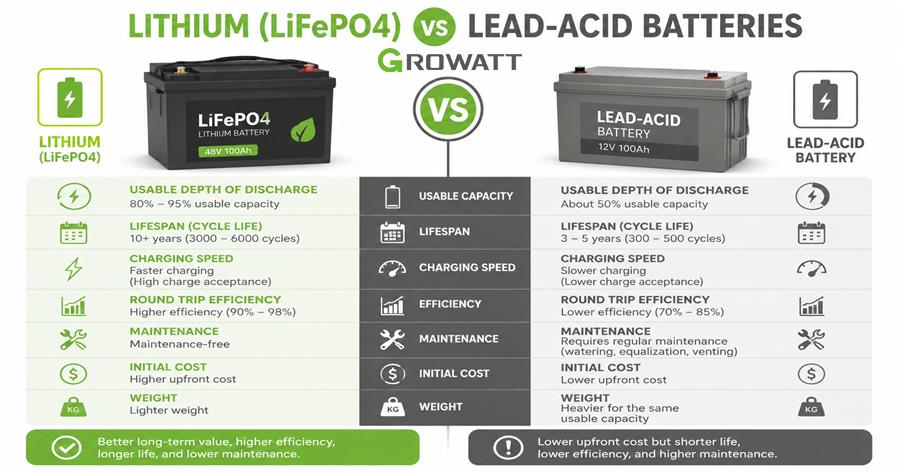
Lead acid batteries – Reduced upfront cost
– readily available
– Duration: shorter (3-5 years)
– Less usable capacity (~50 %) – Requires regular maintenance (watering, equalization, venting) – More weight for the same usable capacity
Lithium batteries offer better long-term value in most residential off-grid installations, despite their higher upfront cost.
Before selecting a battery bank, it is worth comparing the growatt lithium battery price with its usable capacity and expected cycle life to determine its long-term value.
Common Mistakes When Sizing Batteries
Careful solar battery bank sizing allows an off-grid system to continue operating reliably during extended periods of cloudy weather.
Years of experience have shown me several common mistakes:
– No inverter loss calculations
– missing 5-10% conversion losses means under-sized battery banks.
– Future loads under-estimation
– New appliances or increased usage will require more capacity over time.
– Choosing too few autonomy days
– There are more long stretches of cloudy weather than most expect.
– Frequent deep discharging
– Routinely exceeding the suggested depth of discharge will greatly lower the lifespan of the battery, particularly in lead-acid chemistries.
Many homeowners focus only on the initial growatt price, but proper battery sizing and system efficiency often have a greater impact on the total cost of ownership.
Sizing Recommendations in Practice
Consider the following for best overall system performance:
– Measure actual energy use with a plug-in energy monitor, or utility bills if available.
– Consider seasonal differences, e.g. lower solar insolation and perhaps higher heating load in winter.
– Add a safety margin of 10-20% to your final battery capacity calculation.
Buy good batteries from well known manufacturers that publish cycle life data.
– Follow the battery voltage exactly as per the specification of your inverter.
– Planning for future expansion – choose a battery system that can accommodate additional parallel strings or higher capacity modules.
Although a solar battery sizing calculator can provide an initial estimate, final battery selection should always consider real-world operating conditions and future energy requirements.
Conclusions
A thorough solar battery capacity calculation can significantly improve the reliability, efficiency, and long-term value of an off-grid solar installation. Accurate battery capacity calculation for an off-grid solar inverter is crucial for reliable power delivery, optimal battery life and cost-effective system design. By taking the time to evaluate your daily energy usage, days of autonomy, depth of discharge, system voltage and inverter efficiency, you will be able to confidently select the right battery bank size for your needs.
Whether you’re building a weekend cabin or a full-time off-the-grid residence, proper battery sizing is the foundation of a reliable and efficient solar power system. For users planning an off-grid installation in the Middle East, checking available battery and inverter options from growatt uae can help simplify system design and future expansion planning.
If you have questions about your own load calculations or would like help reviewing a system design, please contact us using the information on this site.
Take your time, run the numbers, and when in doubt, lean toward a little extra capacity. You won’t regret it.
Have questions or want a second opinion on your battery math? Drop a comment or reach out .
To calculate battery size, first determine your daily energy consumption in watt-hours (Wh). Then multiply it by the number of desired autonomy days and divide the result by the system voltage, battery depth of discharge (DoD), and inverter efficiency.
A household consuming approximately 5kWh per day and requiring two days of autonomy typically needs around 10kWh of usable energy storage. In many cases, this translates to a 48V lithium battery bank of approximately 300Ah.
An undersized battery bank may discharge too quickly, provide insufficient backup during cloudy periods, and experience more frequent deep cycling, which can reduce battery lifespan and compromise system reliability.
Moderate oversizing can provide additional backup and accommodate future energy needs. However, excessive oversizing may significantly increase system costs without delivering proportional benefits.
Depth of discharge determines how much of a battery's stored energy can be safely used. Batteries with higher allowable DoD, such as LiFePO4 batteries, provide more usable energy and generally offer longer service life.
For medium to large off-grid installations, a 48V system is generally more efficient because it operates at lower current levels, reducing cable losses and improving overall system performance.
Lithium batteries typically offer deeper discharge capability, longer cycle life, faster charging, and lower maintenance requirements. Although their initial cost is higher, they often provide better long-term value for residential off-grid systems. How do I calculate the battery size for an off-grid solar system?
How many batteries do I need for a 5kWh daily load?
What happens if my solar battery is undersized?
Is it better to oversize a solar battery bank?
Why is battery depth of discharge important?
Is a 48V system better than a 24V system for off-grid applications?
Are lithium batteries better than lead-acid batteries for off-grid solar systems?